AI Summary
5 min readIn the spring of 1945, the United States began the final push to defeat the Japanese Empire. For years, American soldiers and Marines had struggled across Pacific beaches, through jungles, and up mountains against a nation that refused to surrender. The effort had been immense, but more was required. Victory in Europe seemed within reach, but victory over Tokyo remained on the horizon—and the American public, sensing the finish line, would soon learn there were still miles to go.
The Firebombing of Tokyo
For months, hundreds of B-29s had been striking Japanese cities from 30,000 feet, aiming for pinpoint bombing of industrial targets. It didn't work. The winds at that altitude were too strong, blowing bombs all over the place. Under the command of General Curtis LeMay, the Army Air Forces altered its tactics dramatically. On March 9, 1945, LeMay's B-29s attacked Tokyo from only 5,000 feet using a new weapon: bombs filled with napalm, a gel combined with gasoline that sticks to surfaces and creates fires designed to go out of control.
Continue reading the full summary in the app — free to try.
Read Full Summary →Free • No credit card required
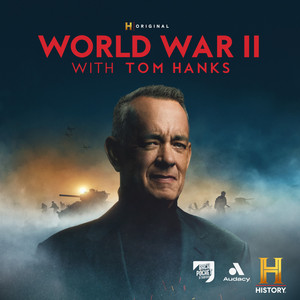
Never miss an episode of World War II with Tom Hanks
Get every new episode summarized in your inbox — free, ~5 minutes to read.
No spam. Unsubscribe anytime.
What you'll learn
- 1 (00:06) **The Strategic Picture in Spring 1945** - The episode opens by contrasting the imminent end of the European war with the daunting reality of the ongoing Pacific campaign.
- 2 (02:26) **The Firebombing of Tokyo** - General Curtis LeMay radically shifts tactics, leading to the devastating March 9, 1945, firebombing of Tokyo.
- 3 (04:24) **Emperor Hirohito's Calculus** - The destruction pushes Emperor Hirohito to begin seeking an end to the war, driven by a primary concern for preserving his own position and the imperial throne.
- 4 (06:22) **The Strategic Objective: Okinawa** - The U.S. sets its sights on Okinawa as a vital staging ground for the eventual invasion of Japan.
- 5 (08:31) **The Invasion of Okinawa** - The largest amphibious invasion of the Pacific begins, initially meeting no resistance on the beaches before the full Japanese defense materializes.
- 6 (12:02) **The Grinding Battle for Okinawa** - The ground campaign turns into a brutal, static meat-grinder against the main Japanese defensive line at Kakazu Ridge.
- 7 (13:04) **A New President and a New Weapon** - The death of FDR brings Harry Truman to power, who is immediately briefed on the top-secret Manhattan Project and the atomic bomb.
+ Full timestamped outline available in the app
Show Notes
The U.S. determines by early 1945 that Japan will never surrender and will need to be subdued by force. Newly sworn-in President Truman must authorize an invasion of the Japanese home islands at a terrible cost to American lives. Emperor Hirohito hopes to avoid the destruction of his land and people, but his generals are agitating for war. Both men seek a way out, but only one can deploy the most terrible weapon the world has ever seen.
This episode features interviews with (in order of appearance):
- Jon Meacham, presidential historian
- Dan Carlin, podcaster, Hardcore History
- Craig L. Symonds, military historian and author
- Christopher Harding, senior lecturer, University of Edinburgh
- Saul David, military historian and author
- Noriko Kawamura, professor, Washington State University
- Yuki Tatsumi, senior director, Institute for Indo-Pacific Security
- Jonathan Parshall, military historian, US Naval War College
- Robert Citino, senior historian, National WWII Museum
- Martin Morgan, military historian and author
- A.J. Baime, journalist and author
- Sarada Peri, presidential speechwriter and political analyst
- Colonel Douglas Douds, professor, US Army War College
- Bradley Hart, military historian, National WWII Museum
- Dr. Rebecca Grant, national security analyst
More from this podcast
World War II with Tom Hanks →