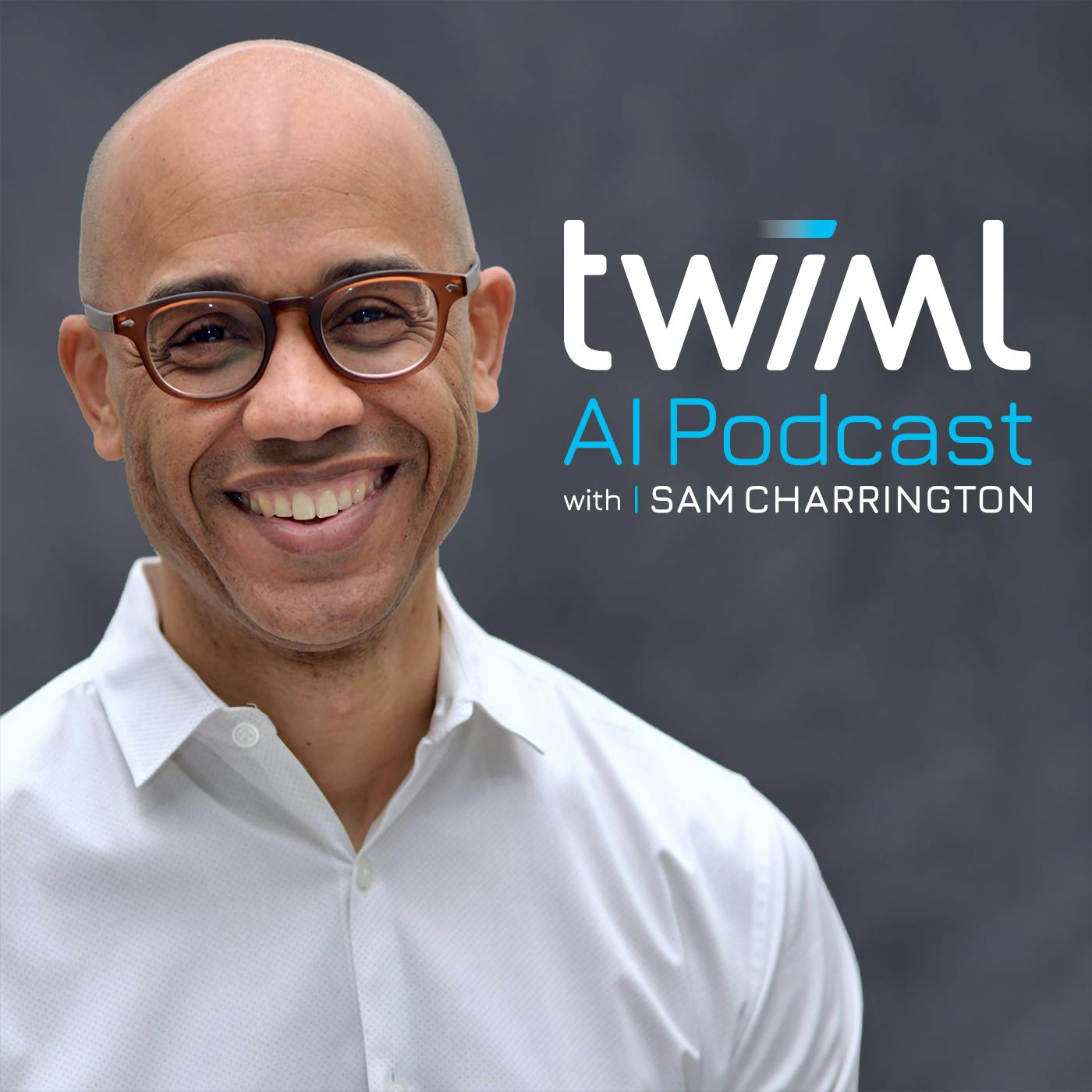
Why the Next AI Breakthrough May Come from Physics with Max Welling
August 25, 2026
AI Summary
5 min readMax Welling, a theoretical physicist turned AI entrepreneur and academic, returned to the TWIML AI Podcast after several years to catch up on his work. He noted that the ideas of equivariance he helped pioneer have found a natural home in chemistry and materials science, where neural networks are now used as surrogate models to predict atomic forces — a calculation that normally requires expensive quantum mechanical approximations. "Three to four orders of magnitude acceleration" is what these models can provide, he said, and this efficiency is what led him to co-found CuspAI in 2024.
From Equivariance to Materials Discovery
The core insight behind CuspAI is that the physical world is symmetric under rotations and translations, and neural networks that respect these symmetries — so-called equivariant models — are far more data-efficient for molecular simulations. Welling's background in theoretical physics made this a natural fit. After two years as a VP at Microsoft Research in Amsterdam, he wanted the faster pace of a startup. Together with co-founder Chad Edwards, he launched CuspAI with an initial $30 million investment and has since grown the team to about 50 people across Amsterdam, Cambridge, London, Berlin, and expanding into Asia and North America. The company's advisory board includes Geoff Hinton, Yann LeCun, former ASML president and CTO Martin van den Brink,
Continue reading the full summary in the app — free to try.
Read Full Summary →Free • No credit card required
Never miss an episode of The TWIML AI Podcast (formerly This Week in Machine Learning & Artificial Intelligence)
Get every new episode summarized in your inbox — free, ~5 minutes to read.
No spam. Unsubscribe anytime.
What you'll learn
- 1 (00:49) **Catching Up with Max Welling** - Sam welcomes Max back to the podcast, and Max reflects on his journey since 2019/2020.
- 2 (03:22) **The Founding of CuspAI** - Max describes how his physics background and work on equivariance led directly to founding CuspAI in 2024.
- 3 (05:25) **CuspAI's Advisors and Mission** - Max highlights the company's all-star advisory board and the core mission to accelerate the energy transition.
- 4 (06:42) **From MOFs to a Materials Design Platform** - Max introduces metal-organic frameworks (MOFs), the class of material that won the 2024 Nobel Prize, and CuspAI's approach to designing them.
- 5 (09:14) **Expanding Beyond Carbon Capture** - Max explains that CuspAI's work has expanded to a wide range of material classes.
- 6 (12:18) **The CuspAI Business Model** - Max details the company's approach to monetizing its materials discovery platform.
- 7 (13:58) **The Agentic Design Pipeline** - Max walks through the multi-step, agent-driven process for designing a new material.
+ Full timestamped outline available in the app
Show Notes
The conventional wisdom in AI is that the next breakthrough will come from more compute, more data, and larger models. But what if the next leap comes from somewhere else? In this episode, Max Welling—co-founder and CTO of CuspAI and professor at the University of Amsterdam—argues that physics may provide some of the ideas behind the next generation of AI systems. We begin with CuspAI’s work using generative AI to design entirely new materials for semiconductors, batteries, carbon capture, and clean energy. Max explains how foundation models for chemistry, agentic workflows, simulation, and automated experimentation are dramatically accelerating the search for new materials and reshaping scientific discovery. The conversation then broadens into a deeper question. Beyond giving AI new scientific problems to solve, can physics also teach us how to build better AI? Max explores surprising connections between machine learning and thermodynamics, why waves may become a new computational primitive for neural networks, and how concepts like symmetry breaking and statistical physics could inspire AI architectures beyond today’s scaling paradigm. 🗒️ Full show notes: https://twimlai.com/go/774.
More from this podcast
The TWIML AI Podcast (formerly This Week in Machine Learning & Artificial Intelligence) →