AI Summary
5 min read🎙️ The Voices & The Context
- The Format: Casual chat between hosts, blending experiments, anecdotes, and science explanations with live demos and a real-time phone call.
- The Key Players:
- Just Hosts: Michael Stevens (Vsauce creator, quirky storyteller with personal anecdotes) and Hannah Fry (mathematician, precise explainer). Their banter is playful—Michael's wild hypotheticals spark laughs, Hannah grounds with facts; main topic is human orientation in space and self-location.
- The Vibe: Fun, educational, mind-bending—mix of spooky thrills (avalanches, space vomit) and awe at brain hacks.
🗝️ Key Themes & Topics
The episode explores how humans sense position in space, from body cues to brain maps, blending physiology, neuroscience, and culture. Four main topics: sensory orientation, brain navigation systems, cultural influences on space perception, and the "ego center" in the body.
- Topic 1: Sensory Cues for Orientation. Vision, inner ear (vestibular system with fluid canals), and proprioception help detect up/down and body position. Disorientation in avalanches (drool trick), space (vomit reflex), surfing (bubbles), carsickness, pilot "graveyard spins," and Michael's "top shelf vertigo."
- Topic 2: Brain's Internal GPS. Hippocampus place cells (fire at specific locations like Google Maps pins) and entorhinal grid cells (hexagon
Continue reading the full summary in the app — free to try.
Read Full Summary →Free • No credit card required
Never miss an episode of The Rest Is Science
Get every new episode summarized in your inbox — free, ~5 minutes to read.
No spam. Unsubscribe anytime.
What you'll learn
- 1 (00:00) **Intro Experiment: Locating "Yourself" in the Body**
- 2 (04:04) **Sensing Orientation and Gravity**
- 3 (12:42) **Personal Vertigo and Proprioception**
- 4 (19:02) **Brain's Cognitive Mapping: Place Cells**
- 5 (26:38) **Grid Cells and Navigation Efficiency**
- 6 (40:00) **Language Shapes Spatial Awareness**
- 7 (44:47) **Ego Center: Where "I" Reside in the Body**
+ Full timestamped outline available in the app
Show Notes
If someone asked you to point to yourself, where would you point? Your chest? Your head? Somewhere just behind your eyes?
Where are you?
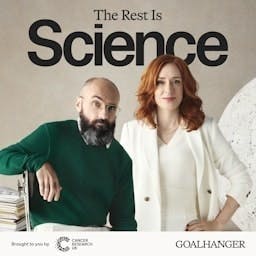
In this episode, Professor Hannah Fry and VSauce’s Michael Stevens explore how the brain maps and understands out location, from the inner ear fluid that tells us which way is up, to the grid and place cells that build a kind of internal GPS.
But how do London taxi drivers rewire their brains to memorise entire cities when the rest of us can’t? How does language change the way we orient in space? And what happens when your senses disagree about your where in the world you are?
Moving from avalanches and virtual reality to ancient philosophy and modern neuroscience, Hannah and Michael move from how to find ourselves on a map to how locating the “self” inside the body may be one of the deepest mysteries in science.
Why did Aristotle believe the self lived in the heart instead of the head? If we’re asked to find the self where do we point? What does it mean to say that you are somewhere…at all?
-------------------
For more information about Cancer Research UK, their research, breakthroughs and how you can support them, visit https://cancerresearchuk.org/restisscience.
Cancer Research UK is a registered charity in England and Wales (1089464), Scotland (SC041666), the Isle of Man (1103) and Jersey (247). A company limited by guarantee. Registered company in England and Wales (4325234) and the Isle of Man (5713F). Registered address: 2 Redman Place, London, E20 1JQ.
-------------------
Find The Rest Is Science all over the internet by clicking here.
-------------------
Video Producer: Adam Thornton + Oli Oakley
Video & Social: Bex Tyrrell
Researcher: Hannah Dodd-Vastiau
Assistant Producer: Imee Marriott
Senior Producer: Lauren Armstrong-Carter
Head Of Digital: Samuel Oakley
Exec Producer: Neil Fearn
Learn more about your ad choices. Visit podcastchoices.com/adchoices
More from this podcast
The Rest Is Science →