AI Summary
5 min readThe Hole In Your Brain That Makes You Doomscroll
Five times as often, people will electrocute themselves with a pen if you don't tell them which pens are safe. In a 2016 experiment, 54 students were led into a room with a bowl of joke pens—some would deliver a shock, some wouldn't. When researchers told participants exactly which pens were dangerous, nobody touched them. But when they simply said "some of these will shock you and some won't," students grabbed the pens five times more frequently, shocking themselves purely to discover which ones would hurt. There was no prize, no game, no dare. Just an information gap they couldn't leave alone.
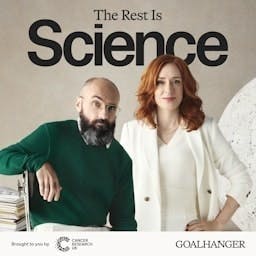
This episode of The Rest Is Science with Michael Stevens and Hannah Ferry traces the strange arc of curiosity—from a sin that theologians called a disease to the name of a Mars rover chosen by a sixth grader. Along the way, it explains what curiosity actually is in the brain, why it evolved, and how the same mechanism that drives learning also powers doomscrolling.
The Information Gap
Continue reading the full summary in the app — free to try.
Read Full Summary →Free • No credit card required
Never miss an episode of The Rest Is Science
Get every new episode summarized in your inbox — free, ~5 minutes to read.
No spam. Unsubscribe anytime.
What you'll learn
- 1 (00:00) **The Pandora Effect: Curiosity Over Self-Preservation** - The hosts introduce the episode with a sealed envelope, framing curiosity as the central theme.
- 2 (06:55) **Curiosity as a Historical Vice** - Hannah details how curiosity was considered a sin for 1,500 years, contrasting it with today's positive view.
- 3 (10:16) **The 1600s Flip: Telescope and Microscope** - The hosts explain how scientific instruments transformed curiosity from a vice into a virtue.
- 4 (13:29) **The Information Gap Theory** - Michael introduces George Loewenstein's 1990s theory, which defines curiosity as a deprivation state.
- 5 (17:52) **Curiosity Primes the Brain for Learning** - The hosts explain how an information gap enhances memory retention.
- 6 (19:37) **Three Steps to Maximize Curiosity** - Michael outlines a formula for creating and exploiting curiosity, using the seven dwarfs as a demonstration.
- 7 (24:03) **Teaching with the Curiosity Gap** - A practical example of using wrong answers to improve learning retention.
+ Full timestamped outline available in the app
Guests on this episode
Show Notes
Why can't you leave a sealed envelope unopened?
Professor Hannah Fry begins by refusing to allow Michael Stevens to open a mystery envelope addressed to him.
A small act of torture that turns out to be the perfect way in to today's subject: curiosity. What is it, why does it feel almost physical, and how far will people actually go just to resolve a nagging uncertainty?
From there Hannah and Michael trace curiosity's surprising reputation through history; how for well over a thousand years it was branded a vice, even a sin, before a couple of inventions flipped it into a virtue almost overnight.
Along the way they delve into the psychology and neuroscience of this itch. Why your brain can't stop worrying at a missing answer, why getting something wrong could be the key to remembering it, and which animals share the drive (and one surprising creature that doesn't).
Plus curiosity's darker side, the way the modern world has learned to hijack the very same circuitry, and a rather lovely story about how a Mars rover got its name.
-------------------
For more information about Cancer Research UK, their research, breakthroughs and how you can support them, visit https://cancerresearchuk.org/restisscience
Cancer Research UK is a registered charity in England and Wales (1089464), Scotland (SC041666), the Isle of Man (1103) and Jersey (247). A company limited by guarantee. Registered company in England and Wales (4325234) and the Isle of Man (5713F). Registered address: 2 Redman Place, London, E20 1JQ.
-------------------
Find The Rest Is Science all over the internet by clicking here.
-------------------
Video Producer: Adam Thornton + Oli Oakley + Jack Meek
Animator: Sam Benson
Video & Social: Bex Tyrrell
Assistant Producer: Lucy Lipscombe
Producer: Simona Rata
Senior Producer: Lauren Armstrong-Carter
Chief Digital Officer: Samuel Oakley
Exec Producer: Neil Fearn
Learn more about your ad choices. Visit podcastchoices.com/adchoices
More from this podcast
The Rest Is Science →