AI Summary
5 min readSomething Weird Is Going On With Placebos
In 1996, pain relief medications were 27.3% more effective than placebo in American clinical trials. By 2013, that number had collapsed to just 8.9%. The drugs hadn't gotten worse. The placebos had gotten better—and this phenomenon appears to be uniquely American.
This strange finding emerged from a 2013 McGill University study by Tuttle and Toyama, who analyzed decades of clinical trial data. They discovered that placebo effectiveness had been rising steadily in the United States since the 1990s, while remaining relatively stable elsewhere. The implications are staggering: if placebos continue improving at this rate, demonstrating that new drugs outperform sugar pills becomes increasingly difficult.
Why American Placebos Are Different
The McGill researchers proposed two explanations for why this is happening only in America. First, clinical trials in the US got significantly longer—from an average of four weeks in 1996 to twelve weeks by 2013. Patients under care for three months simply had more time to experience the benefits of attention and ritual.
Continue reading the full summary in the app — free to try.
Read Full Summary →Free • No credit card required
Never miss an episode of The Rest Is Science
Get every new episode summarized in your inbox — free, ~5 minutes to read.
No spam. Unsubscribe anytime.
What you'll learn
- 1 (02:43) **The Opening Hook: American Placebos Are Better** - Michael drops the central puzzle: placebos are getting more effective over time, and the effect is only happening in America.
- 2 (05:51) **The Tuttle & Toyama McGill Study** - The first major evidence that placebo effectiveness has been rising dramatically over decades.
- 3 (08:56) **Antidepressants: 80% of the Effect Is Placebo** - The phenomenon extends beyond pain to mental health, where the placebo effect dominates.
- 4 (10:27) **Why Only America? Two Hypotheses** - Researchers identified two likely drivers of the American placebo advantage.
- 5 (12:09) **Irene Tracy's "Queen of Pain" Research** - Pain is not an objective signal but a brain-constructed experience, explaining why placebos work better for some conditions than others.
- 6 (13:55) **Two Theories of Why Placebos Work** - Classical conditioning and expectancy provide the mechanistic framework.
- 7 (15:44) **The Harvard Migraine Study: Labeled Placebos** - A landmark experiment showed that even telling people they might be getting a placebo can enhance treatment.
+ Full timestamped outline available in the app
Show Notes
For the past few decades, something strange has been happening in clinical trials. Painkillers aren't getting worse, but the placebos they're tested against appear to be getting better.
In one landmark study, the advantage of pain medication over placebo shrank from 27.3% in 1996 to just 8.9% in 2013.
Even stranger? This trend was found almost entirely in American trials.
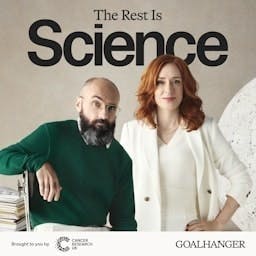
In this episode of The Rest Is Science, Professor Hannah Fry and Michael Stevens (Vsauce) investigate the extraordinary science of the placebo effect;
how our expectations influence pain, why belief can change the way our bodies respond, and what this means for the future of medicine.
Why does the way a treatment is presented matter so much? And how can simply expecting something to hurt actually make it hurt?
But the placebo effect doesn't stop at medicine. From pedestrian crossing buttons that do nothing to the surprising psychology of road safety, Hannah and Michael explore just how easily our expectations can shape our experience of the world.
-------------------
"For more information about Cancer Research UK, their research, breakthroughs and how you can support them, visit https://www.cancerresearchuk.org/our-research/rest-is-science
Cancer Research UK is a registered charity in England and Wales (1089464), Scotland (SC041666), the Isle of Man (1103) and Jersey (247). A company limited by guarantee. Registered company in England and Wales (4325234) and the Isle of Man (5713F). Registered address: 2 Redman Place, London, E20 1JQ."
-------------------
Find The Rest Is Science all over the internet by clicking here.
-------------------
Video Producer: Adam Thornton + Oli Oakley + Jack Meek
Animator: Sam Benson
Video & Social: Bex Tyrrell
Assistant Producer: Lucy Lipscombe
Producer: Simona Rata
Senior Producer: Lauren Armstrong-Carter
Chief Digital Officer: Samuel Oakley
Exec Producer: Neil Fearn
Learn more about your ad choices. Visit podcastchoices.com/adchoices
More from this podcast
The Rest Is Science →