AI Summary
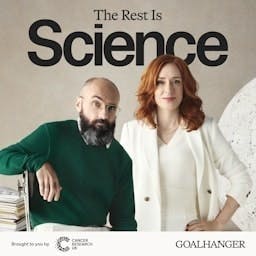
5 min readIt’s the 100th episode of The Rest Is Science, but Michael Stevens immediately refuses to celebrate. The milestone is a trap, he argues, because 100 is a mediocre number—a mere artifact of the human preference for base 10. His co-host Hannah Fry, who is there to defend 100, calls this “incorrect opinion.” What follows is a playful but substantive debate about whether 100 or 101 is the better number, one that roams through ancient counting systems, cognitive psychology, prime numbers, palindromes, the periodic table, and the arbitrary lines humans draw in the sky.
The case against 100: base dependency and the beauty of primes
Michael’s central objection is that 100 is only special because humans happen to have ten fingers. It has no universal significance. He points out that in Northern Europe, the word “hundred” originally meant a “long hundred” of 120 (six score), and what we now call 100 was merely the “short hundred.” Tolkien, an Old English scholar, gave Bilbo Baggins a 111st birthday party to reflect this older, non-decimal sensibility. If an alien species with a different number of digits visited Earth, Michael argues, they would find 100 unremarkable.
Continue reading the full summary in the app — free to try.
Read Full Summary →Free • No credit card required
Never miss an episode of The Rest Is Science
Get every new episode summarized in your inbox — free, ~5 minutes to read.
No spam. Unsubscribe anytime.
What you'll learn
- 1 (00:00) **Episode Setup: 100th Episode Debate** - Michael and Hannah introduce the episode's core question: Is 100 a better number than 101?
- 2 (01:08) **Historical Hundred: The "Long Hundred"** - Michael and Hannah both researched the etymology of 100, discovering it originally meant 120 in Northern Europe.
- 3 (06:31) **Base Systems and Arbitrariness** - The conversation shifts to how number bases make math seem objective when it's actually system-dependent.
- 4 (08:49) **101 is Prime: A Transcendent Property** - Michael introduces the key mathematical argument for 101: it is prime, a property independent of any base system.
- 5 (10:44) **Psychological Value of 100: Threshold Effects** - Hannah pivots to argue for 100 based on human psychology, citing real-world data.
- 6 (12:53) **Rectangles and Human-Centric Value** - Hannah analogizes the importance of 100 to the ubiquity of rectangles in human-made spaces.
- 7 (14:25) **101 as a Palindrome and Palindromic Primes** - Michael argues for 101's coolness as a palindrome in base-10 and discusses palindromic primes.
+ Full timestamped outline available in the app
Guests on this episode
Show Notes
Is 100 really such a special number? Or have we spent thousands of years getting excited about something completely arbitrary?
To celebrate the 100th episode of The Rest Is Science, Professor Hannah Fry and Michael Stevens (Vsauce) go head-to-head in a mathematical showdown: which is the better number, 100 or 101?
It sounds like a simple question, but the answer takes them from the strange history of counting, to the psychology of numbers, the mathematics of primes and the possibility of communicating with alien species.
Why do we find round numbers so satisfying? Would 100 mean anything if we'd evolved with 9 fingers? And is there a single number that’s fundamentally special, regardless of the counting system we use?
Can Hannah and Michael settle the debate once and for all? Or is the most ‘important’ number of all one they haven't even considered yet?
-------------------
For more information about Cancer Research UK, their research, breakthroughs and how you can support them, visit https://cancerresearchuk.org/restisscience
Cancer Research UK is a registered charity in England and Wales (1089464), Scotland (SC041666), the Isle of Man (1103) and Jersey (247). A company limited by guarantee. Registered company in England and Wales (4325234) and the Isle of Man (5713F). Registered address: 2 Redman Place, London, E20 1JQ.
-------------------
Find The Rest Is Science all over the internet by clicking here.
-------------------
Video Producer: Adam Thornton + Oli Oakley + Jack Meek
Animator: Sam Benson
Video & Social: Bex Tyrrell
Assistant Producer: Lucy Lipscombe
Producer: Simona Rata
Senior Producer: Lauren Armstrong-Carter
Chief Digital Officer: Samuel Oakley
Exec Producer: Neil Fearn
Learn more about your ad choices. Visit podcastchoices.com/adchoices
More from this podcast
The Rest Is Science →