AI Summary
5 min readAQ at the UN: The German Collapse That Shaped the 20th Century
Darryl Cooper is three episodes and fifteen hours into his World War II podcast series, and he's still in 1919. That's not digression—it's the whole point. The conventional timeline that begins World War II in 1939, or perhaps with Hitler's rise in 1933, misses what Cooper argues is the essential precondition: the total collapse of German society in the years immediately after World War I, and the brutalizing experience that followed.
The Brutalization Nobody Talks About
Cooper draws on the work of George Mosse, the German-Jewish philosopher of history who developed the theory of "brutalization." The standard version holds that trench warfare in World War I so desensitized German soldiers that atrocities in World War II became possible. Cooper thinks this gets the mechanism wrong.
"The horror that they experienced in the trenches was a predictable horror, almost like a routine horror," Cooper says. Soldiers knew what to expect each day for four years—more dead bodies, more mud, more shelling. It was terrible, but it was contained. What broke men was what came after: the chaotic violence of Germany's post-war collapse, when "you might just wake up one day and your government's been overthrown for the third time" and "men and women in civilian clothes are shooting it out in front of the deli on the street."
Continue reading the full summary in the app — free to try.
Read Full Summary →Free • No credit card required
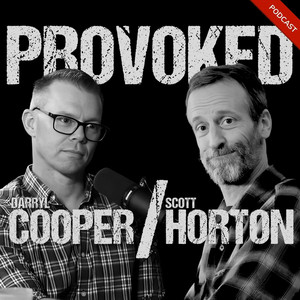
Never miss an episode of Provoked with Darryl Cooper and Scott Horton
Get every new episode summarized in your inbox — free, ~5 minutes to read.
No spam. Unsubscribe anytime.
What you'll learn
- 1 (00:00) **Episode Intro & Host Banter** - The hosts open the show, discuss the length of recent episodes (Darryl’s five-hour WWII podcast, Scott’s seven-hour audiobook chapter), and joke about their busy schedules.
- 2 (05:07) **Why a German Perspective on WWII Now** - Darryl argues it’s time for a dispassionate historical reassessment of WWII, more than 80 years later, and explains why he chose the German viewpoint.
- 3 (09:19) **The Theory of Brutalization and Post-WW1 Chaos** - Darryl explains historian George Mosse’s “brutalization” theory—that trench warfare desensitized Germans—and modifies it to focus on the chaotic post-war years as the key period.
- 4 (14:43) **Government Evaporating Overnight** - Darryl reflects on the profound trauma of waking up to find all government authority—police, bureaucrats—simply gone, leaving people to fend for themselves.
- 5 (19:05) **The British Blockade After WW1** - Scott asks about the role of the British blockade maintained against Germany after the war, and its connection to the rise of communism and the right-wing reaction.
- 6 (26:05) **Parallels Between Post-WW1 Germany and Post-Cold War Russia** - Scott draws parallels between the punitive treatment of Germany after WW1 and the broken promises to Russia after the Cold War, noting both led to resentment.
- 7 (30:56) **What If Bush Had Been Re-Elected in 1992?** - Scott speculates on how history might have differed if Bush Sr. had won a second term, particularly regarding NATO expansion and the Bosnia crisis.
+ Full timestamped outline available in the app
Guests on this episode
Show Notes
In this episode, we discuss the visit of Syrian leader Ahmed Al Sharaa (formerly(?) of Al Qaeda) to the UN... but near the end!
We start by discussing Germany’s experience at the end of World War I, focusing on the collapse of state authority, postwar food shortages, and the rise of militias and political violence. We also examine the Freikorps, anti-communist repression, and the fear that chaos could return at any moment.
We compare this period with later events, including the end of the Cold War, Russia in the 1990s, and debates over NATO expansion and promises to post-Soviet states.
We then turn to current news topics, including speeches at the United Nations, the situation in Syria and the Golan Heights, claims about Iran and U.S. policy, AI-generated misinformation in military decision-making, and recent allegations of racially motivated hangings in the United States.
Chapters (AO):
0:00:00 Intro
0:00:36 Welcome and Book Talk
0:04:05 Germany After the Great War
0:08:05 Brutalization and Chaos
0:19:11 Blockade and Red Scare
0:25:39 Versailles and Broken Promises
0:33:48 NATO and Russian Concerns
0:35:12 Terrorists at the UN
0:39:40 Threats, Iran, and Memes
0:49:27 AI Hallucination Scare
0:53:34 Race Hoax Panic
1:02:23 Questions and Closing Remarks
(Cleaned up w/ the Podsworth app. https://podsworth.com)
Sponsors: Expat Money: Secure your international Plan B: https://expatmoney.com/provoked Agorist Tax Advice: Pick up a free copy of the brilliant Matthew Sercely's Agorist Tax Toolkit at: https://AgoristTaxAdvice.com/provoked Scott Horton Blend Coffee: https://moondoesartisancoffee.com/products/scott-horton-supreme-breakfast-blend
Provoked show site:
Darryl's links:
X: @martyrmade
Scott's links:
X: @scotthortonshow More from this podcast