AI Summary
5 min readBrad Stulberg’s recent Substack essay made a provocative claim: optimization culture is destroying a generation. In a conversation with Cal Newport, Stulberg unpacked why the relentless tracking of metrics—from heart rate variability to social media engagement—is making people miserable rather than better. The conversation landed on a practical alternative: a model Stulberg and Newport call "macro optimization," which treats measurement as a temporary tool rather than a permanent obsession.
Why We Track Everything (and Why It Backfires)
The core problem is not ambition or self-improvement, but the technology that enables real-time tracking of nearly every aspect of life. Until recently, health metrics came once or twice a year at a doctor’s visit. Social comparison happened at weddings or parties. Athletic performance was measured against competitors in a race, not against a dashboard. Now, wearables and analytics provide constant feedback, and the human brain is not built for that.
Continue reading the full summary in the app — free to try.
Read Full Summary →Free • No credit card required
Never miss an episode of Deep Questions with Cal Newport
Get every new episode summarized in your inbox — free, ~5 minutes to read.
No spam. Unsubscribe anytime.
What you'll learn
- 1 (00:08) **The Optimization Thesis** - Brad Stolberg argues that digital technology enables fine-grained measurement across life domains, creating a culture of constant improvement that makes people miserable instead of better performers or happier.
- 2 (02:10) **Defining Optimization Culture** - Brad explains the phenomenon: measuring everything (HRV, steps, tweets, engagement) under the guise of self-improvement, driven by the mantra "if it doesn't get measured, it doesn't get managed."
- 3 (04:42) **The Hidden Costs: False Positives and Anxiety** - Brad introduces "orthosomnia"—the quest for perfect sleep that causes insomnia—and explains how constant health tracking produces anxiety and medical overreaction from false positives.
- 4 (09:05) **Why We Track: The Driving Forces** - Brad offers two theories: (1) people see only the benefits and ignore costs (like with social media), and (2) tracking provides a false sense of control in an uncertain world.
- 5 (14:15) **Simulated Accomplishment vs. Real Difficulty** - Cal argues that focusing on controllable lead indicators (steps, graphs) allows people to flee the hardness and uncertainty of real lag indicators (race placement, book sales).
- 6 (20:58) **Elite Performers Don't Major in the Minors** - Brad describes watching the Toronto Maple Leafs eat carbs and candy without tracking anything, illustrating that world-class athletes focus on fundamentals (ice time, weight room) rather than complex optimization.
- 7 (27:11) **The Self-Focus Trap** - Brad explains that tracking forces constant self-focus, which is antithetical to peak performance and flow states (selflessness, loss of ego).
+ Full timestamped outline available in the app
Show Notes
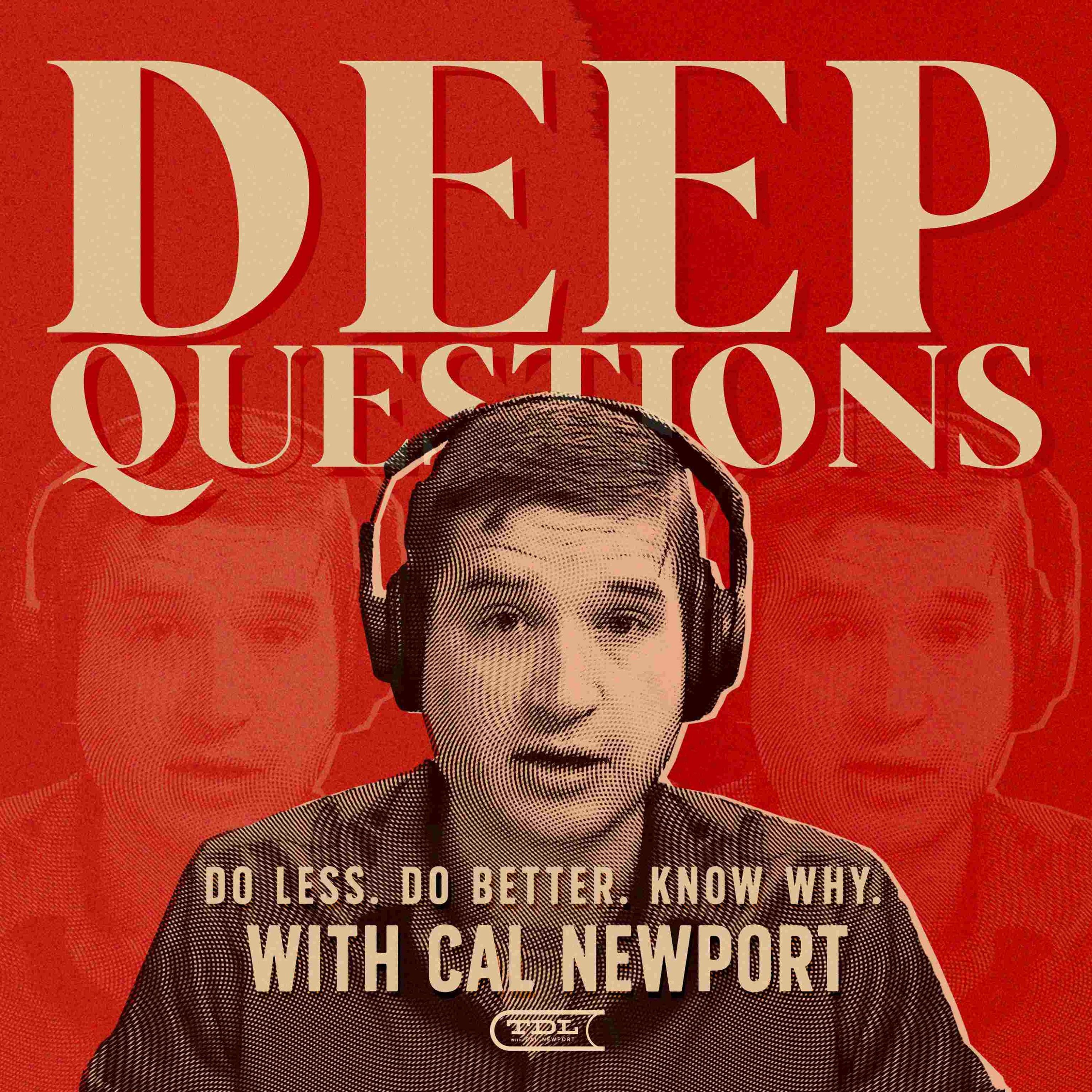
Cal Newport talks with Brad Stulberg to explain the optimization paradox in Episode 414 of the Deep Questions podcast.
Below are the questions covered in today's episode (with their timestamps). Get your questions answered by Cal! Here’s the link: https://bit.ly/3U3sTvo
Video from today’s episode: youtube.com/calnewportmedia
(0:00) The Optimization Paradox
(2:12) Interview with Brad Stulberg
(35:12) Health optimization
(1:09:16) Tail end development
Links:
Buy Cal’s latest book, “Slow Productivity” at www.calnewport.com/slow
Get a signed copy of Cal’s “Slow Productivity” at https://peoplesbooktakoma.com/event/cal-newport/
Cal’s monthly book directory: bramses.notion.site/059db2641def4a88988b4d2cee4657ba?
Thanks to our Sponsors:
https://cozyearth.com (Use code “DEEP”)
Cal Newport is not a Wealthfront client.
Wealthfront’s high-yield cash account: https://www.wealthfront.com/deep. This experience may not be representative of other Wealthfront clients, and there is no guarantee of future performance or success. Experiences will vary. Cal Newport receives cash compensation from Wealthfront Brokerage for paid endorsement in his podcast, creating a conflict of interest. The Cash Account, which is not a deposit account, is offered by Wealthfront Brokerage LLC, member FINRA/SIPC. Wealthfront Brokerage is not a bank. The base APY is 3.30% on cash deposits as of January 30, 2026, is representative, subject to change, and requires no minimum. If eligible for the overall boosted rate of 4.05% offered in connection with this promo, your boosted rate is also subject to change if the base rate decreases during the 3 month promo period. Additional terms and conditions apply, which can be found on wealthfront.com/deep. Funds in the Cash Account are swept to program banks, where it earns the variable APY. Investment advisory services are provided by Wealthfront Advisers LLC, an SEC-registered investment adviser. Securities investments: not bank deposits, bank-guaranteed or FDIC-insured, and may lose value.
Thanks to Jesse Miller for production and mastering, Jay Kerstens for the intro music, and Nate Mechler for research and newsletter.
Learn more about your ad ch
More from this podcast
Deep Questions with Cal Newport →